

Is Manhattan's real estate market gaining momentum or losing steam? The latest numbers suggest both. Third-quarter sales and prices rose, yet contracts declined, showing requests slowed, and buyers became increasingly selective.
It's a seemingly contradictory picture, but one that makes sense when you look beneath the headlines. Manhattan isn't one market. It's a collection of markets, each responding differently to changing economic conditions.
Yesterday's Strength, Today's Caution
According to Compass's Manhattan Q3 2026 Report, closed sales rose 2.7% over last year, and the median price climbed 4.6% to $1.25 million. Yet signed contracts declined 12%.
Closings look backward. Contracts look forward. Much of the third-quarter strength reflects deals negotiated during the spring, the strongest spring market since 2022. Activity cooled over the summer, and the fall has brought fewer showing requests and more deliberate buyers.
Mortgage rates remain a major factor, putting pressure on affordability and making buyers more cautious. But higher borrowing costs affect different buyers very differently.
A Tale of Multiple Markets
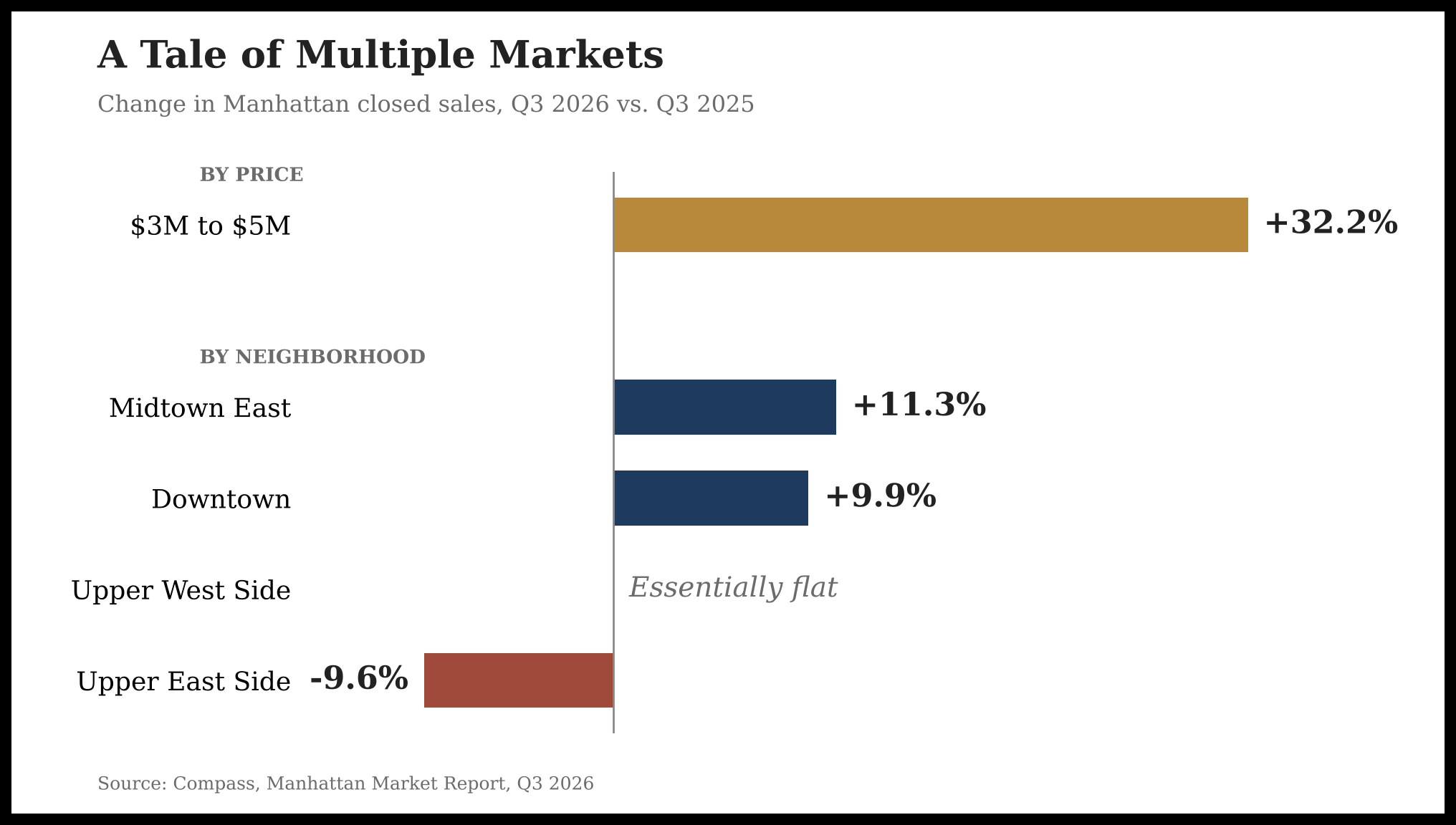
It’s no surprise that the luxury market is outperforming much of the rest. Sales between $3 million and $5 million jumped 32.2% in the third quarter. At a recent industry panel, experts noted that roughly two-thirds of luxury buyers are paying cash, making them less vulnerable to mortgage-rate fluctuations.
At the other end, the $1 million to $2 million segment is particularly challenging. First-time buyers and those dependent on financing face a double squeeze: elevated borrowing costs and high home prices. Some may be adjusting to the higher-rate environment, but others are postponing purchases altogether.
The market also differs dramatically by neighborhood. Downtown sales rose 9.9%, and Midtown East gained 11.3%, while the Upper East Side declined 9.6% and the Upper West Side was essentially flat. Same borough, same quarter, very different results.
The Inventory Paradox
You might expect slower demand to produce more choices for buyers. Not necessarily.
Manhattan's active inventory declined 10.9% from a year ago, while new listings plunged 28.4% to their lowest third-quarter level in a decade.
Higher mortgage rates discourage some existing homeowners from selling, particularly those reluctant to give up low-rate mortgages. Meanwhile, limited new development activity further restricts choices, and high construction costs suggest that future offerings may arrive at even higher prices.
The rental market adds another wrinkle. With rents remaining elevated, the financial gap between renting and owning may be narrowing for some households, even as financing costs remain a hurdle.
What This Means for You
If you're selling, limited competition can work in your favor, but it's no guarantee of success. Buyers are selective, and yesterday's prices don't necessarily reflect today's demand. Notably, 28% of properties took more than six months to enter into a contract.
If you're buying, caution is sensible, but don't confuse caution with opportunity everywhere. Some properties are lingering and offer room for negotiation. Others, especially those with desirable qualities and limited competition, are moving quickly.
The Bottom Line
Markets rarely move in unison. They shift neighborhood by neighborhood, building by building, and price point by price point.
The numbers tell part of the story. Knowing how to interpret them—and what they mean for your particular property—is where experience matters.
If you'd like to know what these trends mean for your building, your block, or your price range, I'm always happy to share my perspective.
Wishing you and yours a warm and wonderful November.
— Shirley